


Boston to Savannah is one of the more romantic swaps on the Eastern Seaboard: triple-deckers for trust-lot townhouses, the T for twenty-two squares laid out in 1733, February slush for Spanish moss. But underneath the postcard is a hard-nosed economic move — a housing market at 24% below the national median, a port-and-manufacturing boom hiring at scale, and a state income tax that keeps ratcheting down. Here’s the whole picture, including the parts the brochures skip.
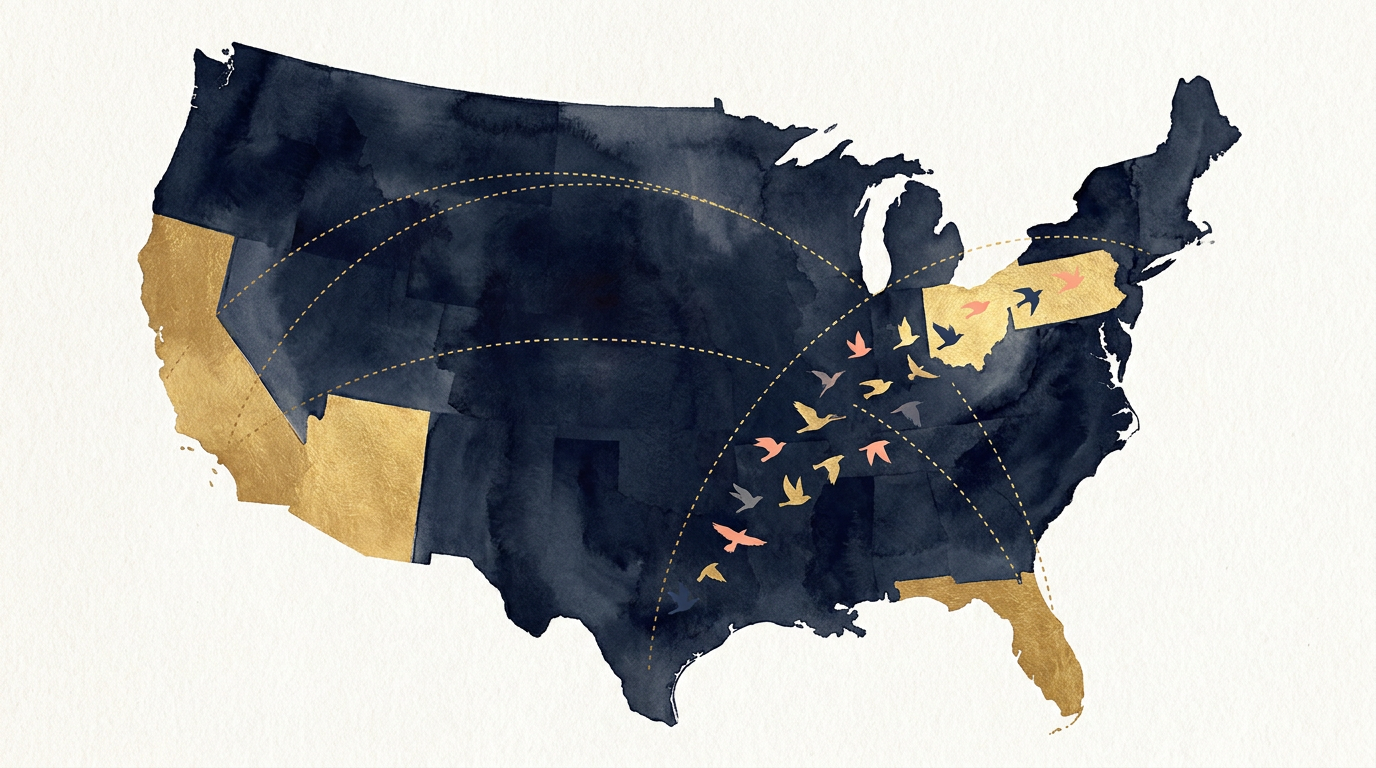
The migration story: New England joins the southbound flock
The macro trend is blunt. In the most recent IRS migration year (2022–2023), Massachusetts lost a net 15,378 tax filers and roughly $3.9 billion in adjusted gross income — one of the largest per-capita outflows in the country. Georgia sat on the other side of the ledger, gaining a net 14,671 filers in the same window, and the coastal corner of the state has been claiming an outsized share of them.
The Savannah metro added more than 90,000 residents between 2015 and 2025 — from roughly 365,000 to about 438,000, a 20% surge that made it one of the fastest-growing metros in Georgia across the last census decade. The inflow is a braid of four streams: Atlanta families cashing out for the coast, Floridians arbitraging their own state’s insurance costs northward, retirees hunting a milder ledger, and — the stream you’d join — Northeasterners from New York, New Jersey, Pennsylvania and Massachusetts chasing housing they can actually buy.
Honesty requires a caveat: Boston-to-Savannah is a real corridor, but a modest one. More Bostonians land in Atlanta, Charlotte or Tampa than on the Georgia coast. The ones who pick Savannah tend to pick it deliberately — for the port economy, for Gulfstream, for SCAD, or because they toured the Historic District once and never quite recovered.

Why they move: the tax and cost math
Run the numbers honestly and — as with most Massachusetts-to-Southeast moves — this is not really an income-tax story. It’s a housing story with a tax subplot.
| Category | Boston, MA | Savannah, GA |
|---|---|---|
| State income tax | 5% flat, plus a 4% surtax on income over ~$1.08M | 4.99% flat for 2026 (cut from 5.19%; scheduled triggers keep trimming toward 3.99%) |
| Median home price | ~$852K | ~$339K (Redfin, three months ending May 2026) |
| Property tax | ~0.97% effective statewide; Boston bills land on a very large base | Chatham County rates are comparable per dollar — but levied on a home worth 60% less |
| Sales tax | 6.25% | 7% combined in Chatham County (4% state + local) — one line where Georgia costs more |
| Retirement income | Mostly taxed | Social Security exempt; up to $65K/person of retirement income excluded at 65+ |
| Cost of living | ~$7,424/mo lifestyle… | …runs ~$5,200/mo here (Salary.com index) |
Read that table plainly: a W-2 earner under seven figures pays essentially the same income-tax rate in both states in 2026 — 5% versus 4.99% is a rounding error, though Georgia’s scheduled cuts will widen the gap in its favor over the next few years. High earners escape Massachusetts’ millionaire surtax, and retirees do dramatically better under Georgia’s exclusions. For everyone else, the savings live in the mortgage: the same monthly payment that services $852K of Boston housing buys you the median Savannah home twice over, with money left for the porch fan.
Where to land: four neighborhoods that actually fit ex-Bostonians
Ardsley Park Families
Savannah’s answer to West Roxbury with better trees — a 1910s planned streetcar suburb of oak-canopied medians, Craftsman and Colonial Revival homes, and neighbors who wave. Typical sales run around $525K, which still stings less than a Boston condo, and midtown’s schools and parks are the draw. Ten minutes to downtown, no bridge traffic.
Starland District Creatives
The Victorian-era blocks south of Forsyth Park turned art district: galleries, coffee roasters, vintage shops and SCAD energy. Renovated homes trade near $410K — roughly $200K under the Historic District — and it’s the most walkable, least car-dependent landing spot in the city. If you’re leaving Somerville or JP, start here.
Isle of Hope Waterfront calm
A bluff-and-marsh peninsula fifteen minutes southeast, where historic cottages sit under 300-year-old oaks and the marina points at the Skidaway River. It ranks among the safest neighborhoods in the metro and feels like a permanent Sunday. You give up walkability; you get sunrise over the water.
Pooler New construction
The boomtown west of the city where most of the metro’s new builds are going up — master-planned communities minutes from I-95, the airport, Gulfstream’s campus and the Hyundai Metaplant. It’s the practical choice for commuting households that want a 2020s house with a warranty instead of an 1890s house with a story.
Housing market reality in 2026
Savannah in mid-2026 is what Boston buyers dream about at open houses: a market that has actually cooled. The median sale price sits near $339K — down 3.1% year over year — at about $197 per square foot, and the typical home takes around 82 days to sell with a single offer. That’s 24% below the national median and a different universe from Boston’s perennial bidding wars. Zillow pegs the average home value at roughly $336K and drifting slightly down, which means buyers can negotiate, inspect, and sleep on it — verbs that don’t exist in Greater Boston.
Two asterisks belong on that sunshine. First, coastal Georgia’s property-insurance market has been repricing hurricane risk, and premiums on the islands and in flood zones can be a four-figure surprise — get an insurance quote before you fall in love east of the Truman Parkway. Second, the cooling is uneven: renovated homes in Ardsley Park and Starland still move fast, while the discount lives in houses that need work.
If you plan to rent first — a sensible way to audition neighborhoods before buying — the average Savannah rent sits near $1,710 a month, a figure that wouldn’t cover a studio in most of Greater Boston. That gap is the quiet engine of this whole migration: a couple paying Boston rent can bank the difference for a year and have a Savannah down payment. Landlords here still ask for first month and a deposit, not the first-last-security-broker gauntlet Boston renters have been trained to accept as normal.
Jobs and the economy: jets, containers, and EVs
Savannah’s economy stands on three legs, all growing. Gulfstream Aerospace is headquartered here — the region’s flagship private employer, with a workforce of 15,000+ worldwide and hundreds of Savannah openings in engineering, manufacturing and MRO at mid-2026. The Port of Savannah, run by the Georgia Ports Authority, is one of the busiest container ports in the country, and port activity supports roughly 85,000 jobs across coastal Georgia in logistics, warehousing and rail. And just west of town, Hyundai’s Metaplant America — the company’s first dedicated EV mass-production campus, built for up to 500,000 vehicles a year — has been hiring by the thousand as it ramps, pulling a supplier ecosystem into the county behind it.
Round it out with healthcare (St. Joseph’s/Candler and Memorial Health, the region’s Level I trauma center), Fort Stewart–Hunter Army Airfield, Georgia-Pacific, and SCAD’s creative economy, and you have a genuinely diversified base.
Now the honest line: comparable roles pay roughly 19% less than Boston, and Boston’s biotech-and-finance salary ceiling simply doesn’t exist here. The movers who win this trade bring remote Boston income with them, get recruited into aerospace, port or medical roles at competitive rates, or have stopped optimizing for income altogether. If your career depends on a dense professional-services market, price that in before the truck is loaded.
The honest trade-offs
The heat is a lifestyle. May through September runs steamy 90s with humidity that makes August in Boston feel quaint; you will live by air conditioning, and the sand gnats in spring are a local hazing ritual. Hurricane season is real. Chatham County has evacuation zones, and insurance costs are climbing coast-wide — budget for it. The wage ceiling is lower, as covered above. You will drive. Outside the Historic, Victorian and Starland districts, Savannah is a car city with thin transit. The airport is not Logan — SAV is pleasant but small, and many international trips connect through Atlanta. Schools are pockets, not a blanket — strong options exist, but they require research the way Boston suburbs don’t. And downtown belongs partly to tourists: 17 million visitors a year means your prettiest streets come with tour trolleys.
Budget for the first-year adjustments, too. If you lived carless in Boston — plenty do — you’ll almost certainly need a vehicle here, which is a five-figure line item the cost-of-living calculators don’t show. Summer power bills climb with the air conditioning that southern life requires; a hurricane kit and a written evacuation plan are things responsible coastal Georgians simply have; and if you buy east of town, flood insurance may be a condition of the mortgage, not a choice. None of these outweigh the housing math. All of them belong in it.
Planning the move
| Home size | Full-service movers (2026) |
|---|---|
| Studio / 1 bedroom | $1,800–$4,500 |
| 2 bedrooms | $3,000–$6,300 |
| 3 bedrooms | $4,500–$8,600 |
| 4+ bedrooms | $7,000–$12,500 |
Packing services add roughly $250–$500 for an apartment and $1,000–$1,800 for a full house. Portable containers and consolidated freight can undercut those ranges if your dates are flexible. Timing matters twice here: October through April is both the cheap season for movers and the pleasant season for arriving in Savannah — land in fall and you get six months of perfect weather to fall for the place before your first July bill. Book 6–8 weeks out, further for a summer move.
On logistics, three practical notes from people who’ve run this exact route. First, get at least three written binding estimates — the Boston-to-Southeast corridor is thick with brokers reselling your move to the lowest bidder, and a binding estimate from an actual carrier is your best protection. Second, if your dates are flexible, ask about consolidated loads: Boston to the Southeast is a well-trafficked lane, and sharing a truck can cut the bill by a third. Third, think hard before driving a rental truck yourself the whole 1,015 miles — I-95 through New York, the Beltway and the Carolinas in a 26-footer is a two-day endurance event that surprises people who’ve never done it.
FAQ
How much does it cost to move from Boston to Savannah?
Most 2–3 bedroom households pay $3,000–$7,600 for full-service movers in 2026. Studios can come in under $2,000 with a consolidated load; large four-bedroom homes with packing services can reach $12,500.
How far is Savannah from Boston, and how long does the move take?
About 1,015 miles door to door — a 15–16 hour drive down I-95 that most people split over two days. Professional van lines typically deliver in 2–6 business days, stretching toward two weeks during June–August peak season.
Will I actually save on taxes moving from Boston to Savannah?
On income tax, barely — Georgia’s 4.99% flat rate for 2026 is a rounding error from Massachusetts’ 5%, though Georgia’s rate keeps falling and high earners escape the 4% millionaire surtax. The real savings are housing (a ~$339K median versus ~$852K) and retirement income, which Georgia shelters generously at 65+.
What’s the best Savannah neighborhood for someone from Boston?
Starland District for walkable, creative city living (think Somerville with palms, ~$410K); Ardsley Park for families (~$525K); Isle of Hope for waterfront quiet; Pooler for new construction near Gulfstream, the port and the Hyundai Metaplant.
When is the best time to move from Boston to Savannah?
October through April. You’ll pay less for movers than in the summer peak, skip loading a truck in Savannah’s 95-degree humidity, and arrive in time for the coast’s best months.
Keep exploring
Sources: IRS SOI & Census state-to-state migration data; Tax Foundation 2026 state income-tax rates & Georgia DOR 2026 rate schedule; Redfin market data (three months ending May 2026); Zillow home values; Salary.com cost-of-living index; moveBuddha & Allied 2026 route pricing; Georgia Ports Authority economic-impact study; Savannah Area Chamber major-employers data.