

Moving from New York to Jacksonville is one of the quieter stories inside America’s loudest migration corridor. While Miami gets the headlines, a steady stream of New Yorkers has been choosing North Florida’s biggest city instead — and for a blunt, unglamorous reason: the math works better here than almost anywhere else in the state. Jacksonville’s median home costs roughly a quarter of Manhattan’s, Florida takes nothing out of your paycheck, and the beach is twenty minutes from downtown.
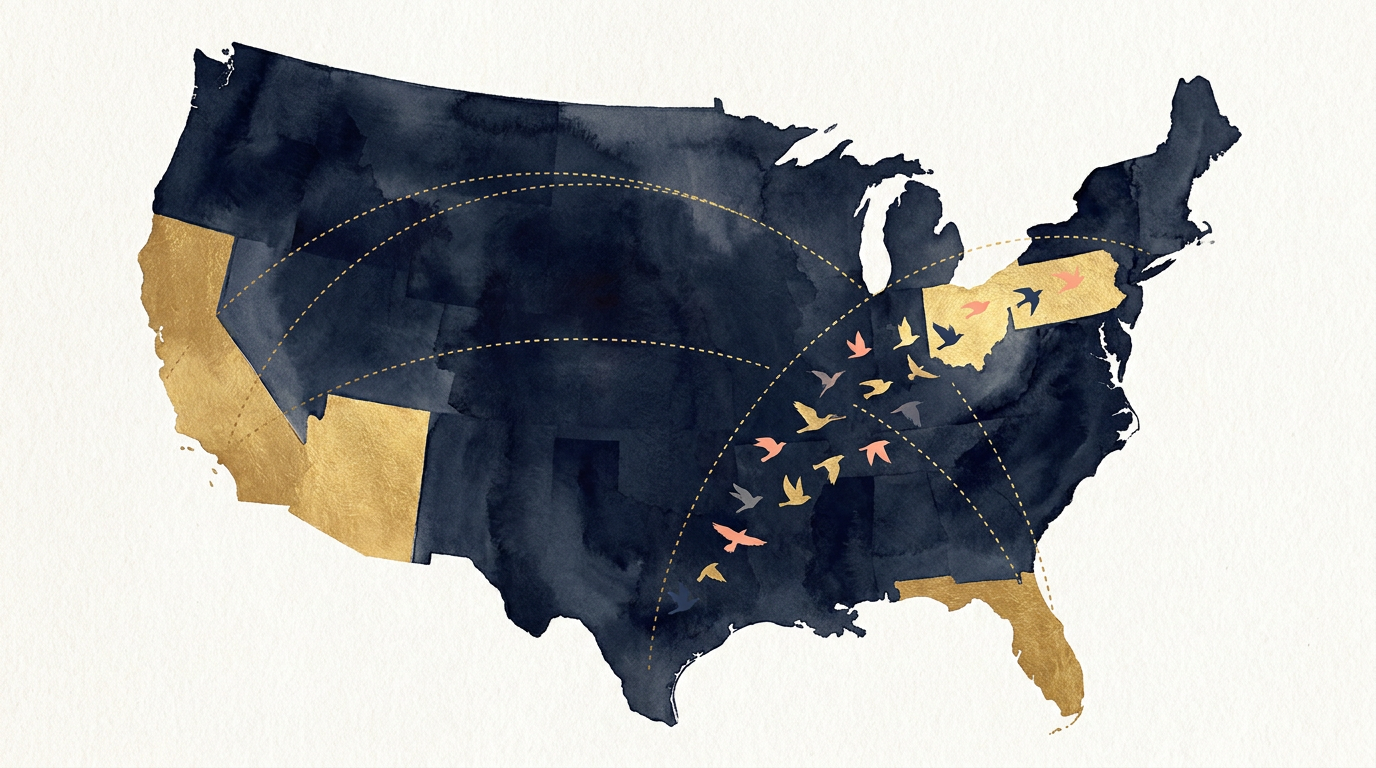
The migration story: a decade of New Yorkers heading south
The IRS tracks migration through address changes on tax returns, so this flow is measured, not guessed. In the most recent published year (2022–2023), New York lost a net 71,987 tax filers to other states — more than any state but California — while Florida gained a net 55,349, the largest inflow in the country. The New York–to–Florida corridor alone carries roughly 72,000 people south every year, and it has run in the same direction for every one of the past ten years.
Jacksonville’s share of that river has grown steadily. The metro added roughly 25,000–30,000 net new residents a year between 2020 and 2024, with 2026 tracking toward another 18,000–22,000. New York consistently ranks among the top origin states, alongside New Jersey, California, Illinois and Georgia. Growth is concentrated in St. Johns County to the south and the newer suburbs of northern Duval.
Who makes this particular move? Two groups dominate: young professionals priced out of Miami and Tampa — Jacksonville’s median home runs about half of Miami’s — and families doing the space-per-dollar calculation, for whom a Brooklyn one-bedroom budget buys a four-bedroom house with a yard in a good school zone. Unlike the Miami flow, this is rarely a status move. It is an arithmetic move, and the arithmetic is below.
One honest note on trajectory: the Northeast-to-Florida flow peaked in the 2021–2022 remote-work surge and has cooled since, as return-to-office policies bite and the most motivated movers have already gone. It has cooled, not reversed — every published year of the past decade still shows the same direction, and Jacksonville keeps growing while some pricier Florida metros have begun to plateau.
Why they move: the tax and cost gap
A New York City resident pays three layers of income tax: federal, state (4% to 10.9% across nine brackets) and city (3.078% to 3.876%). At the top, that stacks to nearly 14.8% of income before federal tax — the heaviest combined state-and-local income tax in America. Florida’s number is simpler: zero. A household earning $150,000 typically keeps $10,000–$14,000 more per year from the income-tax change alone.
| New York City | Jacksonville | |
|---|---|---|
| State income tax | 4%–10.9% (9 brackets) | None |
| City income tax | 3.078%–3.876% | None |
| Median home price | Manhattan ~$1.25M–$1.4M; Brooklyn ~$882K | ~$305K citywide |
| Median rent | Manhattan $5,295/mo (record high, June 2026) | ~$1,576/mo average |
| Effective property tax | Varies widely; NY suburbs often 2%+ | ~0.77% in Duval County (~$2,566/yr on a median home) |
| Sales tax | 8.875% | 7.5% |
| Overall cost of living | — | 35–45% lower |
Tax rates: NY Dept. of Taxation, Tax Foundation, 2026. Housing: Redfin, Zillow, PropertyShark, Q2 2026. Property tax: Ownwell / Duval County Property Appraiser.
Florida’s homestead exemption knocks up to $50,000 off the taxable value of a primary residence — and on the November 3, 2026 ballot, Florida voters will decide whether to raise it substantially further. One honest offset: homeowners insurance. Florida’s hard insurance market means budgeting several thousand dollars a year, though Jacksonville sits well below South Florida’s coastal premiums, and state regulators approved average multiperil cuts of roughly 8.8% effective July 1, 2026. Net-net, most New York transplants still come out far ahead — but run your own numbers with insurance included.
Beyond housing: the everyday-cost gap
The savings do not stop at rent and taxes. Comparative cost-of-living data puts Jacksonville’s everyday expenses — groceries, dining, utilities, services — roughly 15–25% below New York’s, with childcare close to half price, one of the largest single line-item swings for young families. Car insurance and gas replace MetroCards in the budget, and Florida’s insurance costs claw some savings back, but analyses of this corridor consistently land in the same place: a $150,000 household frees up roughly $40,000–$60,000 a year in total cost of living by trading New York City for Jacksonville. That single number, more than any beach photo, is why this route stays busy.

Where to land: four neighborhoods New Yorkers actually choose
Jacksonville is enormous — the largest city by land area in the contiguous United States — so “moving to Jacksonville” means very different things depending on the zip code. These four areas absorb most of the Northeast transplants.
Riverside & Avondale Historic + artsy
The closest thing Jacksonville has to Brooklyn: leafy streets of restored 1920s bungalows and Tudor revivals, the Five Points district’s independent cinema, vintage shops and rooftop bars, and a genuine local art scene anchored by the Cummer Museum. Riverside’s median sits around $320,000; polished Avondale runs closer to $470,000. If you are leaving Park Slope or Astoria and dreading suburbia, start here.
San Marco Walkable classic
Built around a 1920s square modeled on Venice’s Piazza San Marco — lion fountain included — with boutiques, galleries and some of the city’s best restaurants within a stroll. It is one of the few genuinely walkable pockets in Florida, five minutes across the river from downtown. Median prices hover around $505,000, the price of its charm and location.
Jacksonville Beach & Atlantic Beach Salt life
Twenty minutes east of downtown, the Beaches are their own small towns: surf culture, oceanfront bars, a walkable town center in Atlantic Beach, and a morning routine that starts with sand underfoot. Expect a meaningful premium over the citywide median, but a fraction of what any coastal address costs in the New York metro.
Nocatee Master-planned families
Technically in St. Johns County — home to some of Florida’s top-rated public schools — Nocatee is one of the best-selling master-planned communities in America: resort-style water parks, nature trails, town centers and a golf-cart lifestyle. Medians around $660,000 make it the premium family option, still modest by Westchester or Long Island standards.
The housing market in 2026: calmer than you expect
After the 2020–2022 surge, Jacksonville has settled into something New Yorkers rarely experience: a balanced market. The citywide median sale price is about $305,000 — up just 0.9% year over year per Redfin, while Zillow’s home-value index actually reads slightly negative. Homes take around 60–67 days to sell, receive about two offers, and the metro carries roughly 3.4 months of inventory. Sellers accept about 95% of list on average.
Translation: no all-cash bidding wars, room to negotiate, and time to do inspections properly. At $187 per square foot, Jacksonville costs a fifth less than the national average — and a small fraction of the $1,000+ per square foot common in Manhattan. The caveats: insurance and HOA costs need line-item attention (especially on condos), and new-construction supply in the suburbs keeps a lid on resale appreciation. Buy for the life, not for a quick flip.
Renting first: the smart landing pattern
Most New Yorkers who make this move well do it in two steps: rent for a year, then buy. Jacksonville makes that cheap to do. The average apartment rents for about $1,576 a month — against a record $5,295 median in Manhattan and $4,350 in Brooklyn as of June 2026 — so a transplant household can bank the difference while learning the city. Rental supply is healthy thanks to years of new construction, which keeps landlords negotiable on concessions, especially in the urban-core towers.
A year of renting answers the questions no listing can: whether you want San Marco’s walkability or Nocatee’s schools, how you tolerate an August, what your real commute looks like, and which side of the river fits your life. It also lets you shop for a house in Jacksonville’s balanced market at your own pace — a luxury the 2021 version of this city never offered.
One New York habit to drop immediately: broker fees. They are not a thing here. Application fees, a deposit, and first month’s rent are typically all it takes.
Jobs and the economy: finance, health care and the Navy
Jacksonville quietly runs one of the largest financial back-office economies in the country. Four Fortune 500 companies are headquartered here in 2026 — including rail giant CSX (25,000+ employees company-wide) and title-insurance leader Fidelity National Financial — alongside fintech heavyweight FIS. Health care is the other pillar: Baptist Health employs about 12,000, the Mayo Clinic’s Florida campus about 8,450, and insurer Florida Blue another 5,700. Add two major Navy installations — NAS Jacksonville and Naval Station Mayport — plus Amazon’s regional logistics network, and you get an unusually diversified mid-size economy.
The honest 2026 picture, though, is cooling. Metro unemployment sat at 4.7% in May 2026, up more than a point from a year earlier, and Northeast Florida shed a net 3,000 jobs over the trailing twelve months — with financial activities down 3,600 positions. If you are moving with a remote New York salary, the math is spectacular. If you are moving to job-hunt locally, expect Southern pay scales and a slower market than the 2021–2023 boom: line up the offer before the lease.

The honest trade-offs
The heat is real. May through September is hot, thick and stormy — the season when you live between air conditioners. Northeasterners usually flip their complaint calendar: winters become the reward, summers the price.
Hurricanes and insurance. Jacksonville is historically less hurricane-exposed than South Florida, but not immune — Irma flooded riverfront neighborhoods in 2017. Budget seriously for homeowners insurance and read any condo’s reserve study before buying.
You will drive everywhere. Jacksonville sprawls across ~840 square miles with thin transit. After a life measured in subway stops, two cars per household is the default. San Marco, Riverside and the Beaches are the walkability exceptions.
Paychecks shrink with the rent. Local salaries run well below New York’s, and the finance sector is trimming in 2026. The move works best with a portable income or a signed offer.
The culture flips. Jacksonville is a Southern city: slower, friendlier, quieter after 10pm. There is a real food-and-brewery scene and an NFL team, but no one will pretend it is a 24-hour town. Direct flights are thinner from JAX than JFK — count on connections for international trips.
Planning the move: costs, timing, logistics
| Home size | Typical 2026 cost (full-service movers) |
|---|---|
| Studio / 1-bedroom | $1,000 – $3,900 |
| 2-bedroom | $2,000 – $5,100 |
| 3-bedroom | $2,800 – $7,350 |
| 4+ bedroom house | $4,500 – $8,600 |
Ranges compiled from published 2026 corridor estimates (moveBuddha, My Good Movers and industry quotes). Your price moves with weight, date and service level.
Timing: The corridor’s cheapest months are September through April. Summer weekends and month-end dates carry the highest rates and the tightest crews; mid-week, mid-month moves routinely save 10–20%. Book 4–8 weeks ahead in the off-season, longer for a summer move. Get at least three written, in-home (or video-survey) estimates, and treat any quote wildly below the ranges above as the red flag it is.
Making the tax move stick
If lower taxes are part of your reason for moving, treat residency as paperwork, not vibes. New York State runs aggressive residency audits on high earners who claim to have left; the burden of proof sits on you. The standard playbook: spend fewer than 183 days a year in New York, and move your “domicile” convincingly — Florida driver license (required within 30 days anyway), Florida voter registration, Florida-registered vehicles, updated estate documents, and a filed Florida homestead exemption (deadline: March 1 for the year you claim it). Keep a travel log for your first two years. It is dull, and it is what separates the people who actually save $14,000 a year from the people who get a bill for it back.
Frequently asked questions
How much does it cost to move from New York to Jacksonville?
Most professional moves run $1,000–$3,900 for a studio or one-bedroom and $2,100–$5,100 for a two- to three-bedroom home, with large houses reaching $7,000–$8,600. The average full-service move lands around $3,000–$5,000.
How far is Jacksonville from New York, and how long does the move take?
About 940 miles via I-95 — roughly a 14-hour drive, usually split over two days. Movers typically deliver within 3–7 business days of pickup.
How much will I actually save on taxes?
Florida has no state or city income tax, versus a combined 7–14.8% for New York City residents. A $150,000 household typically keeps $10,000–$14,000 more per year, and Duval County’s effective property tax (~0.77%) is modest. Offset a portion for homeowners insurance.
What is the best Jacksonville neighborhood for ex-New Yorkers?
Riverside/Avondale and San Marco for walkable, historic, restaurant-rich living; the Beaches for surf-town life; Nocatee for families chasing top-rated St. Johns County schools.
When is the best time to make this move?
September through April — rates are lower, crews are easier to book, and you skip both New York winter moving hazards at one end and peak Florida heat at the other. Mid-week, mid-month dates are cheapest.
Keep exploring
Sources: IRS Statistics of Income migration data; Tax Foundation and NY Department of Taxation rate tables; U.S. Census and Momentum Realty migration analyses; Redfin, Zillow, Houzeo and PropertyShark housing data; Ownwell / Duval County Property Appraiser; U.S. Bureau of Labor Statistics, Jax Daily Record and Jacksonville Today labor reporting; Insurify and MoneyGeek insurance data; published 2026 moving-industry corridor estimates. Figures current as of July 2026 and provided for general guidance; verify tax and residency specifics with a licensed professional. Reviewed by the MovingExperts editorial team.