

Most Northeast-to-Sunbelt route pages tell one story: sell high, buy low, pocket the difference. Philadelphia to Atlanta doesn’t work that way, because Philadelphia is already one of the most affordable big cities in the Northeast — and Atlanta is no longer cheap. What this corridor offers instead is one of the strongest job markets in the country, a real income-tax cut for city dwellers, winters that don’t hurt, and — for many Philadelphia families — something closer to a homecoming.
The migration story: the I-85 lane of a national pattern
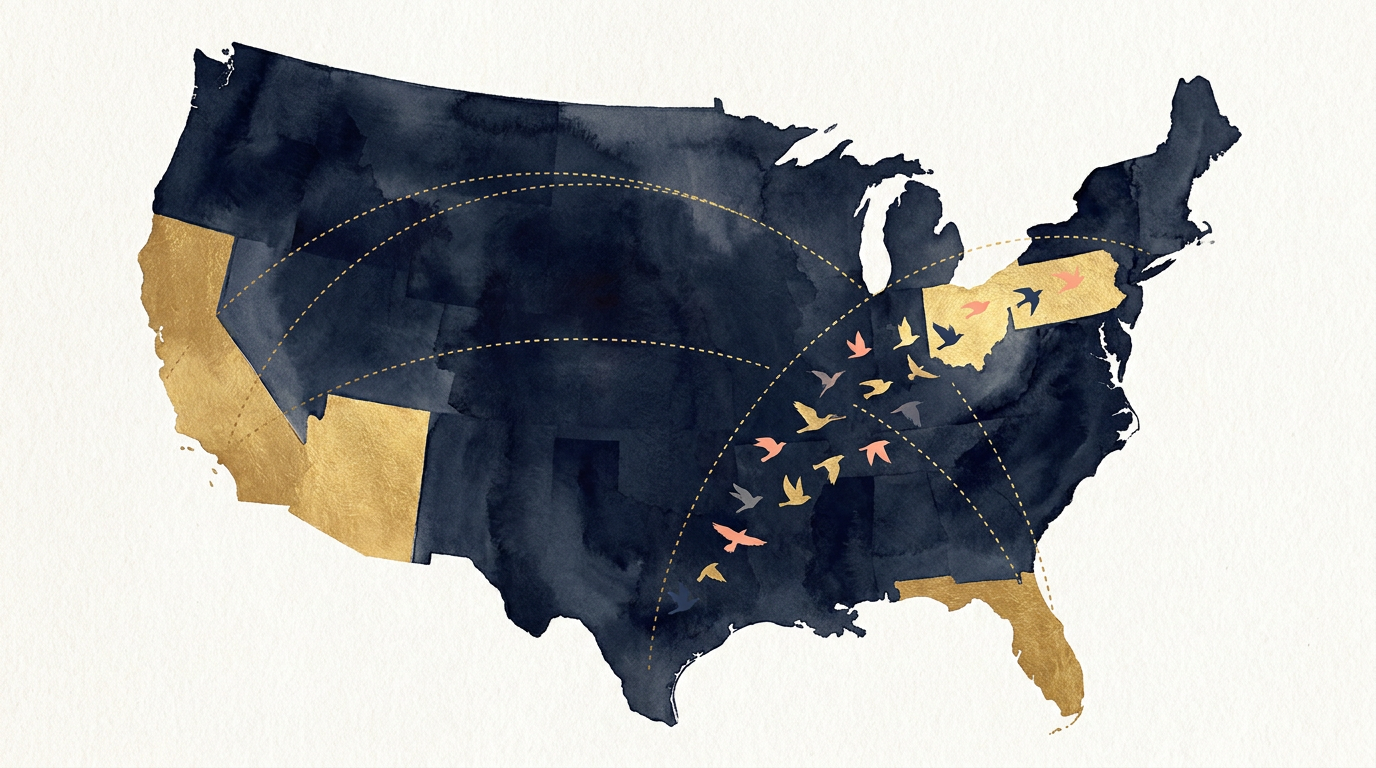
The Philadelphia → Atlanta corridor sits inside the most persistent migration pattern in modern America: the Northeast feeding the Sunbelt. In the most recent IRS accounting (2022–2023), Pennsylvania lost a net 12,095 tax filers to other states while Georgia gained a net 14,671 — and both numbers extend decade-long streaks. Pennsylvania’s biggest losses flow south, and metro Atlanta is one of the two or three great collection basins for that flow.
But this route carries more history than most. Atlanta has been the center of the “reverse Great Migration” for two decades — and Philadelphia was one of the great destinations of the original Great Migration. A meaningful share of the people making this move are returning to states their grandparents left: back toward family land in Georgia and the Carolinas, but to a metro with Fortune 500 jobs rather than the rural South their families departed. For Black professionals especially, Atlanta’s pull — the universities, the business networks, the political and cultural infrastructure — has no real rival in America.
The rest of the flow looks like the corridor’s economics: young professionals chasing a 2.8%-unemployment job market, remote workers trading Northeast winters for a leafy city where January highs average in the 50s, and families following employers that keep relocating operations south. Direct flights help too — Philadelphia and Atlanta are two hours apart by air on one of the busiest domestic routes in the country, which makes the move feel less final than a jump to Texas or Arizona. Plenty of people on this corridor keep a foot in both cities for years.
What the flow is not, mostly, is retirees. Georgia’s retirement-income exemptions are generous, but the Philadelphia retiree bound for the South overwhelmingly picks Florida or the Carolinas coast. Atlanta pulls working-age people — the metro’s median age sits years below Philadelphia’s — and that shows up in everything from the job market to the nightlife to the daycare waitlists.

Why they move: the tax and cost math
Here’s the honest version of the spreadsheet. Numbers are 2026 figures; home prices are city-level medians from Redfin data over the three months ending May 2026.
| Category | Philadelphia | Atlanta |
|---|---|---|
| State income tax | 3.07% flat (PA) | 4.99% flat (GA, 2026) |
| City wage tax | ~3.75% (resident rate) | None |
| Combined income tax | ~6.8% (city resident) | 4.99% |
| Median home price | ~$290K | ~$429K |
| Effective property tax | 1.3998% of assessed value | ~1.05% (Fulton Co. median) |
| Overall cost of living | Essentially a wash — indexes put the two cities within ~1–3% of each other | |
Read that table twice, because it cuts both ways. If you live in Philadelphia and pay the city wage tax, Georgia’s 4.99% flat rate is a real raise — nearly two points of your income back every year, plus no separate city income tax anywhere in metro Atlanta. If you live in the Pennsylvania suburbs and pay 3.07% plus a ~1% township earned-income tax, Georgia is a modest tax increase. Whole route guides get written without admitting that; now you know.
Housing is the bigger surprise. Philadelphia’s median sale price (~$290K) runs 21% below the national average — it is the affordable big city of the Northeast. Atlanta’s (~$429K) now runs above the national average, and prices there rose roughly 9% over the past year against Philadelphia’s 3.5%. Rent is the one place Atlanta gives some of it back: average rents run modestly cheaper than Philadelphia’s, and metro-wide there’s far more new construction competing for your lease.
Where to land: four neighborhoods that actually fit ex-Philadelphians
Atlanta is a city of neighborhoods the way Philadelphia is — it just hides them under a tree canopy. These four map surprisingly well onto Philly sensibilities.
Old Fourth Ward BeltLine
Fishtown-and-Northern-Liberties energy, Atlanta edition. The BeltLine’s Eastside Trail runs through it, Ponce City Market anchors it (think a Bok Building that swallowed a Reading Terminal), and it’s one of the few districts where you can genuinely live on foot and bike. The trade: it’s priced like the hottest neighborhood in the city, because it is — medians around $550K and homes moving in under 30 days.
West Midtown Loft district
Warehouses turned lofts, breweries, design studios — the trajectory Callowhill and Brewerytown keep promising, but a decade further along. New builds cluster near the BeltLine’s developing west side, with medians around $500K. Best fit for buyers who want new construction without moving to the suburbs.
Decatur Schools
Chestnut Hill with its own city government. A walkable historic square, festivals, bookstores, and the metro’s most coveted small school system. It draws transplants relentlessly — including film-industry arrivals — and prices accordingly. If your Philadelphia calculus was “Mt. Airy, for the trees and the neighbors,” start here.
East Atlanta Village Eclectic
Dive bars, music venues, and a fierce local identity — East Passyunk’s scrappier cousin, with yards. It remains one of intown Atlanta’s relative values, and the housing stock (bungalows and shotgun houses) will feel pleasantly un-rowhouse. Nearby Kirkwood and Grant Park offer similar value if EAV’s nightlife isn’t your speed.
Housing market reality in 2026
Set expectations now and the market won’t bruise you later. Intown Atlanta — anything near the BeltLine loop — is expensive and competitive: the city median hit roughly $429K this spring, up about 9% year over year, and well-priced homes in the neighborhoods above draw multiple offers fast. BeltLine proximity carries a measurable premium because the infrastructure is real and still expanding.
The metro’s escape valve is its sheer size. Move one ring out — Tucker, Smyrna, Austell, parts of South Fulton and Gwinnett — and prices fall meaningfully below the city median, which is how Atlanta still ranks well on housing affordability relative to income in national comparisons. Property taxes help too: Fulton County’s median effective rate of ~1.05% undercuts Philadelphia’s 1.3998%, and Georgia’s homestead exemptions shave more off for owner-occupants.
Our standing advice on this corridor: rent for six months first. Atlanta’s neighborhoods vary block by block, commutes dominate quality of life here, and the rental market — softer than Philadelphia’s, with more new supply — makes a test year cheap insurance against buying in the wrong quadrant of a 20-county metro.
Jobs and the economy: the Southeast’s headquarters city
This is the argument for the move. Metro Atlanta’s unemployment rate was 2.8% in April 2026 — tenth-lowest among all 108 U.S. metros with a labor force over 250,000 — and the economy underneath it is unusually diversified. Delta Air Lines, The Home Depot, UPS, and Coca-Cola are all headquartered here; Emory University and its health system anchor an eds-and-meds sector a Philadelphian will recognize; the CDC makes Atlanta a public-health capital; and the fintech corridor processes a huge share of America’s card transactions. Add the film industry — the soundstage complexes south of the city rival anything outside Los Angeles — plus major Microsoft and Google engineering offices in Midtown, and you get a job market where losing one employer doesn’t strand you.
Two practical notes for the Philadelphia professional. First, eds-and-meds skills transfer cleanly: Emory, Grady, Piedmont, and Children’s Healthcare of Atlanta are perpetual hirers, and Georgia Tech feeds the same hospital-tech pipeline Penn and Drexel do. Second, Hartsfield-Jackson is the busiest airport in the world, which sounds like trivia until you’re a consultant, a salesperson, or someone with family spread across three time zones — the nonstop map from ATL makes PHL look regional.
The honest trade-offs
Every route page we publish includes this section, because the move only works if you make it with open eyes.
- You will probably not save on housing. Worth repeating: the city median in Atlanta is roughly $140K higher than Philadelphia’s. Sellers of Philly rowhomes arrive here as modest buyers, not cash-rich ones. The savings on this route are income-tax (city residents only), property-tax rate, and salary-growth savings — not sticker-price savings.
- Heat and humidity are real. June through September runs 88–95°F with humidity to match. You’ll trade shoveling snow for scheduling life around air conditioning three months a year.
- The car wins here. MARTA’s rail system is genuinely useful along its two spines — and nothing like SEPTA’s reach. Most of the metro is drive-everywhere, and the Downtown Connector at rush hour is among the worst traffic in America. If you loved living car-free in Center City, confine your search to Midtown, O4W, or Decatur, or budget for a second car.
- Suburb-to-suburb movers lose the tax argument. PA’s 3.07% plus a township EIT is still lighter than Georgia’s 4.99%. Run your own numbers before you let a tax pitch sell you the move.
- Culture shift. Sprawl instead of rowhouse density, sweet tea instead of Wawa (there is no Wawa; make peace with QuikTrip), and a sports culture that will politely ignore your Eagles gear. Atlanta is friendly, transient, and forest-quiet in ways that feel disorienting for about six months — then most transplants stop noticing.
Planning the move
| Move type / home size | Estimated cost (2026) |
|---|---|
| Full service — studio / 1-bedroom | from ~$1,873 |
| Full service — 2–3 bedroom | $2,774 – $6,396 |
| Full service — 4–5 bedroom | up to $9,048+ |
| Moving container (all sizes) | $1,270 – $4,353 |
| Freight trailer (all sizes) | $1,154 – $3,279 |
| Rental truck (DIY) | $628 – $1,813 |
Professional packing adds roughly $312–$2,080 depending on home size. The route itself is one of the easiest long hauls on the East Coast — interstate the entire way, no mountain passes, and enough carrier volume between the Northeast and Atlanta that transit times stay short and competitive quotes are easy to gather. Winter moves price lowest; if you must move in June–August, get three quotes and book at least a month out.
Two timing details specific to this corridor. First, if you’re driving your own car down, avoid leaving Philadelphia on a Friday — I-95 through the D.C. beltway region can add two hours by itself; many movers on this route run the I-81/I-77 inland alternative for exactly that reason. Second, Atlanta’s rental cycle peaks in early summer when film-production and university calendars turn over together; if you’re renting first (which we recommend), you’ll see the best selection in spring and the best prices in late fall.
FAQ
How much does it cost to move a 3-bedroom from Philadelphia to Atlanta?
Roughly $3,000–$6,400 with a full-service long-distance mover in 2026, per current route data. Moving containers run about 30% less; freight and rental trucks less still.
How far is Philadelphia from Atlanta, and how long does the move take?
About 783 miles by road — a ~12-hour drive via I-95 and I-85. Professional van-line transit typically takes 2–6 business days on this corridor.
Will I save money on taxes by moving from Philadelphia to Atlanta?
If you live in Philadelphia proper, yes: you trade ~6.8% combined state and city wage tax for Georgia’s 4.99% flat rate, and property-tax rates are lower too. If you’re moving from the Pennsylvania suburbs, Georgia’s income tax is actually slightly higher than PA’s 3.07% plus a typical township tax — run your own numbers.
Is housing cheaper in Atlanta than Philadelphia?
In the city proper, no — Atlanta’s median sale price (~$429K) is well above Philadelphia’s (~$290K) in 2026. Rents are modestly cheaper in Atlanta, and the metro’s outer suburbs offer more house per dollar, but this is not a housing-discount move.
What’s the best Atlanta neighborhood for someone from Philadelphia?
Old Fourth Ward for walkable, BeltLine-centered city living (Fishtown energy); Decatur for schools and a walkable square (Chestnut Hill vibes); West Midtown for lofts and new construction; East Atlanta Village for eclectic value with yards.
Keep exploring
Sources: IRS SOI & Census state-to-state migration data (2022–2023); Georgia Dept. of Revenue / HB 1001 2026 flat-rate schedule; City of Philadelphia Dept. of Revenue wage-tax rates; Tax Foundation 2026 state tax data; Redfin market data (three months ending May 2026); Fulton County & Philadelphia OPA property-tax data; U.S. Bureau of Labor Statistics metro employment (April 2026); moveBuddha Philadelphia–Atlanta route dataset (May 2026).