


Every year, thousands of New York households trade subway delays, $876,000 median homes, and the heaviest combined income-tax bill in America for the Mojave Desert — a city where the median house costs roughly half as much, the state takes nothing out of a paycheck, and the sun shows up about 300 days a year. This guide covers what the move actually costs in 2026, who is making it, where transplants land, and the honest trade-offs nobody puts in the brochure.
The migration story: a decade of one-way traffic
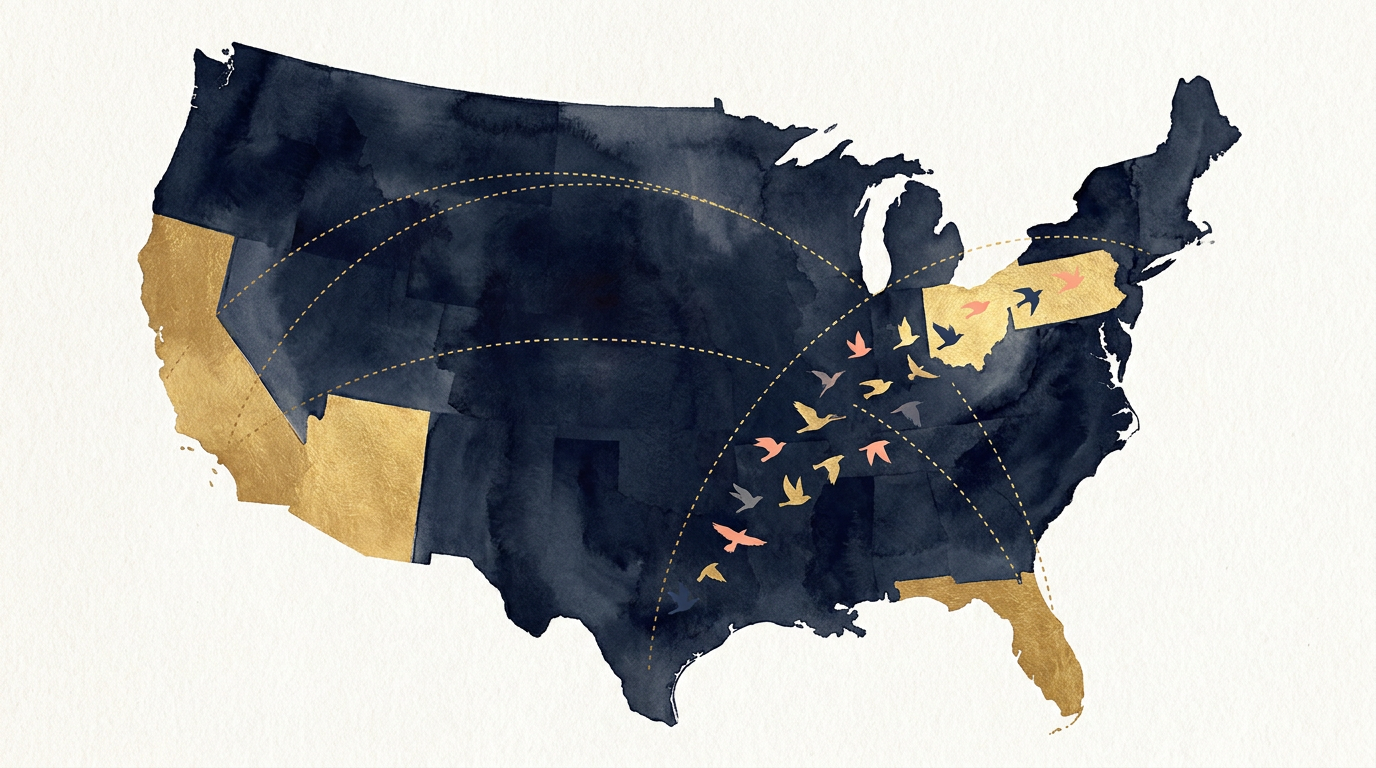
New York has spent the past decade as America’s biggest people-exporter. IRS Statistics of Income data show the state lost a net 74,482 tax returns to other states in the 2022–2023 filing period alone, and Tax Foundation analyses estimate New York has surrendered on the order of $111 billion in adjusted gross income to other states over the past decade — more than any state in the country. The traffic is overwhelmingly one-way, and it flows toward states that don’t tax income: Florida, Texas, Tennessee — and Nevada.
On the receiving end, Clark County (the county that contains Las Vegas, Henderson, and North Las Vegas) has become one of the top migration magnets in the United States. The county netted +7,524 tax filers from interstate migration in the most recent IRS data, and added roughly 38,000 net new out-of-state residents in the latest twelve-month window. California supplies the largest single stream, but New York consistently ranks among the top feeder states — and the New York cohort skews toward exactly the households the tax math favors most: remote-capable professionals, retirees cashing out of appreciated real estate, and small-business owners who can domicile anywhere.
Who makes this move? Three groups dominate. First, remote and hybrid professionals who discovered after 2020 that a New York salary spends very differently in a zero-income-tax state. Second, retirees and near-retirees cashing out of appreciated Northeast real estate — the sale of a median Queens house funds a Henderson house outright, with six figures left for the brokerage account. Third, hospitality and entertainment workers moving within their own industry, trading New York’s restaurant grind for a resort economy where their skills are the region’s core export.
The pattern is old enough now to be self-reinforcing. Ex-New Yorkers land in Summerlin and Green Valley, their friends visit in March (when Las Vegas is at its best), and a year later the friends are pricing movers. A decade of that loop turned what used to be a novelty relocation into a well-worn corridor — direct flights between JFK/Newark and Harry Reid International run all day, which matters more than people expect when grandparents, clients, and college kids are still back East.

Why they move: the tax and paycheck math
The single biggest line item in this move is invisible — it’s the tax you stop paying. A New York City resident faces state income tax of 4–10.9% plus a city income tax of 3.078–3.876%, for a combined top rate near 14.8% — the heaviest state-and-local income tax burden in the country. Nevada’s rate on wages, capital gains, and retirement income is zero. Analyses of 2026 rates put the annual savings for a $250,000 NYC household at roughly $20,000–$25,000 — every single year.
| New York City | Las Vegas (Clark County) | |
|---|---|---|
| State income tax | 4–10.9% | None |
| City income tax | 3.078–3.876% | None |
| Combined top rate | ~14.8% | 0% |
| Effective property-tax rate | ~1.4–1.6% NY state average (higher in the suburbs) | ~0.5–0.6%, with a 3% annual cap on primary-residence increases |
| Sales tax | 8.875% | 8.375% |
| Median home sale price | ~$876,000 | ~$480,000 |
Be honest about the fine print, though. Nevada funds itself somewhere, chiefly through sales tax (Clark County’s 8.375% is barely below NYC’s), gaming revenue, and fees — so the “zero tax” headline really means “zero income tax.” And if you keep New York ties — an apartment, an office, more than 183 days a year — New York’s tax department is famously aggressive about residency audits. Establish Nevada domicile cleanly: driver’s license, voter registration, and a genuine primary residence.
Where to land: four neighborhoods that make sense for New York transplants
Las Vegas’s premier master-planned community, hugging the Red Rock Canyon side of the valley. Golf courses, A-rated schools, Downtown Summerlin’s shopping-and-dining core, and the valley’s best hiking out the back door. Median prices run about $680,000 — the top of the local market, and still a discount on brownstone Brooklyn. This is where relocating Manhattan professionals most often land.
Technically its own city southeast of the Strip, Henderson is the “quietly excellent suburb” option — consistently ranked among the safest mid-size cities in America. Listing prices average around $530,000, while the older, tree-lined Green Valley section runs nearer $470,000. Strong schools, parks, and a 25-minute commute to the Strip’s job core.
The closest thing Las Vegas has to a Brooklyn analog: galleries, breweries, coffee roasters, and First Friday street festivals in the 18b Arts District, plus the restored mid-century neighborhoods around it. Condos and townhomes start around $280,000–$350,000 — the cheapest entry point in this guide, and one of the few places in the valley where you can live semi-car-light.
An unincorporated, deeply diverse district west of the Strip with some of the valley’s best value per square foot and its strongest Asian food scene along Spring Mountain Road. Competition is real — Spring Valley is one of the areas where homes most often sell above list — but it remains a practical first landing spot for buyers priced out of Summerlin.
Housing market reality in 2026
The Las Vegas market of 2026 is competitive but no longer feverish. The metro median single-family sale price sits near $480,000 (Redfin, mid-2026), with Clark County overall around $450,000 — up from roughly $310,000 five years ago. About 35% of homes sell above list price, with the sharpest competition in Henderson, Summerlin, and Spring Valley, and local forecasts project 3–5% appreciation through the year. For a seller leaving the New York metro, the arithmetic is friendly: the ~$876,000 median NYC sale funds a Summerlin house with equity left over, or a Green Valley house nearly twice over.
Renters get relief too: median rent runs about $1,550 — around half of what a comparable NYC unit commands, and for far more square footage. That makes renting for the first six to twelve months a genuinely sensible strategy here: neighborhoods in the valley have distinct personalities, the drive from Summerlin to Henderson crosses the entire metro, and you’ll want a summer under your belt before committing to a specific corner of it.
One caution on carrying costs: property insurance, HOA fees (nearly universal in the master-planned communities), and summer utility bills — think $300+ electric bills in July and August with the air conditioning running around the clock — claw back part of the savings versus the Northeast. Even so, the all-in monthly cost of owning a comparable home typically lands at roughly half the New York metro equivalent, and Nevada’s 3% annual cap on primary-residence property-tax increases keeps the bill predictable in a way New York suburban homeowners will find almost disorienting.
Jobs and the economy: bigger than the Strip
Las Vegas’s economy is still anchored by leisure and hospitality — about 26% of total employment — with the big resort operators (MGM Resorts, Caesars Entertainment, Wynn, the Venetian) among the largest private employers, alongside the Clark County School District and the valley’s hospital systems. But the diversification story is genuine: roughly 60% of new jobs added from 2016 to 2025 came outside hospitality, construction, and government, led by healthcare, professional and business services, and logistics. Pro sports (Raiders, Golden Knights, Aces, and the coming MLB Athletics) have built an entertainment-adjacent white-collar layer that didn’t exist a decade ago.
The honest caveats: metro unemployment was 5.3% in May 2026 — above the national average — and the depth of the white-collar market is nowhere near New York’s. If you’re in finance, law, media, or tech, the strongest play is to bring a remote New York salary with you; Nevada’s workforce grew 1.9% over the past year (the fastest in the nation) and average hourly pay climbed nearly 6%, but a local job search in specialized fields can take longer than it would in Manhattan.
The honest trade-offs
- The heat is not a punchline. Las Vegas is the fastest-warming city in America — average temperatures are up about 2.8°F since 1970 — and July highs average around 104°F, with stretches above 110°F. From June through September you will live indoors at midday, exactly the way New Yorkers live indoors in January.
- Water is a long-term question. The valley depends on the Colorado River and Lake Mead, and the basin is in its driest 25-year stretch in modern records. Southern Nevada’s per-capita conservation program is genuinely the country’s most aggressive (turf removal, recycling nearly all indoor water), but expect strict outdoor-watering rules and rising rates.
- You will need a car. After a lifetime of the subway, this is the biggest lifestyle shift. Transit is thin outside the Strip corridor, and the valley is built at freeway scale. Budget for a vehicle, insurance, and gas — it partially offsets the tax savings.
- The job market is thinner. A 5.3% unemployment rate and a hospitality-weighted economy mean local white-collar searches take longer. The move works best with portable income.
- Culture shift is real. World-class restaurants and residency shows, yes — but no museum mile, no Central Park, and summers that invert your social calendar. Some transplants love the 24-hour rhythm; others miss seasons within a year.
Free calculator
Rent a truck, or hire movers?
See real numbers for a New York → Las Vegas move — we factor in real rental-truck fuel burn (a loaded 26-footer gets ~7–8 mpg), one-way rental, hotels, and gear, then compare it to full-service movers.
Planning the move: logistics, costs, and timing
| Home size | Full-service movers (2026) | Notes |
|---|---|---|
| Studio / 1-bedroom | $2,200–$5,500 | One-way rental truck from about $1,700–$2,400 before fuel and hotels |
| 2–3 bedrooms | $4,000–$8,600 | The most common quote band for this route |
| 4+ bedrooms | $6,500–$13,100+ | Peak-summer dates and packing service push toward the top |
Timing matters more on this route than most. Movers’ peak season (May–September) overlaps exactly with the months you least want to unload a truck in 110°F heat. The sweet spot is October through April: rates drop, crews are easier to book, and you arrive in the half of the year when Las Vegas is at its best. Book 4–8 weeks ahead, get at least three binding estimates, and confirm your carrier’s USDOT registration and delivery-window terms in writing.
A few route-specific notes. If you’re shipping a car rather than driving it (common for households going from zero cars to one), auto transport on this corridor typically runs $1,200–$1,800 and adds a week or two of lead time — book it alongside the household move. If you do drive, treat the last leg seriously in summer: the I-15 stretch through the Mojave is where overloaded vehicles overheat, so travel it early in the day with coolant checked. And whatever the season, don’t load candles, vinyl records, electronics, or anything else that melts into a trailer that will sit in desert heat — carry them in the car. Finally, plan your apartment-or-house hunt around the fact that everything here tours better in person than online; listing photos can’t show you what a west-facing backyard feels like at 5 p.m. in July.
Frequently asked questions
How much does it cost to move from New York to Las Vegas?
Most professional 2–3 bedroom moves run $4,000–$8,600 in 2026; studios start around $2,200 and large family homes can reach $13,100 or more. A one-way rental truck starts near $1,700–$2,400 before fuel, hotels, and four days of driving.
How far is Las Vegas from New York, and how long does the move take?
About 2,521 miles — roughly 37 hours of driving, or four days at a comfortable pace. Full-service carriers typically quote a 7–21 day delivery window on this corridor.
How much will I save on taxes by moving from New York to Las Vegas?
Nevada has no state income tax, versus New York’s 4–10.9% state rate plus NYC’s 3.078–3.876% city tax (a combined top rate near 14.8%). A $250,000 household saves roughly $20,000–$25,000 per year; property taxes are also far lower, at about 0.5–0.6% effective versus New York’s ~1.4–1.6% state average.
What is the best Las Vegas neighborhood for New York transplants?
Summerlin for master-planned amenities and top schools (~$680K median), Henderson/Green Valley for suburban value (~$470–530K), the Downtown Arts District for walkable, creative, condo-priced living ($280–350K), and Spring Valley for value near the Strip’s job core.
When is the best time of year to move from New York to Las Vegas?
October through April. Moving rates fall outside the summer peak, crews are easier to book, and you avoid arriving during 104–110°F desert heat.
Keep exploring
Sources: IRS Statistics of Income migration data and Tax Foundation state migration analysis (2024–2026); U.S. Census Bureau county profiles; Redfin and Zillow market data (May–June 2026); Las Vegas Realtors reporting; U.S. Bureau of Labor Statistics and Nevada DETR labor data (May 2026); Tax Foundation and WalletHub 2026 property-tax rankings; moveBuddha and MyMovingJourney 2026 route pricing; Las Vegas Sun and Climate Central warming data; Southern Nevada Water Authority and Colorado River basin reporting (2026).