

Free calculator
Rent a truck, or hire movers?
See real numbers for a Newark → Dallas move — we factor in real rental-truck fuel burn (a loaded 26-footer gets ~7–8 mpg), one-way rental, hotels, and gear, then compare it to full-service movers.
Every year, thousands of North Jersey households trade the Turnpike, the PATH platform, and the highest property-tax bills in America for a metroplex that has been the fastest-growing in the nation for years running. The Newark-to-Dallas move is a straight trade of density for space, and a tax bill for a thermostat. Here is what the numbers actually look like in 2026 — and what nobody puts in the brochure.
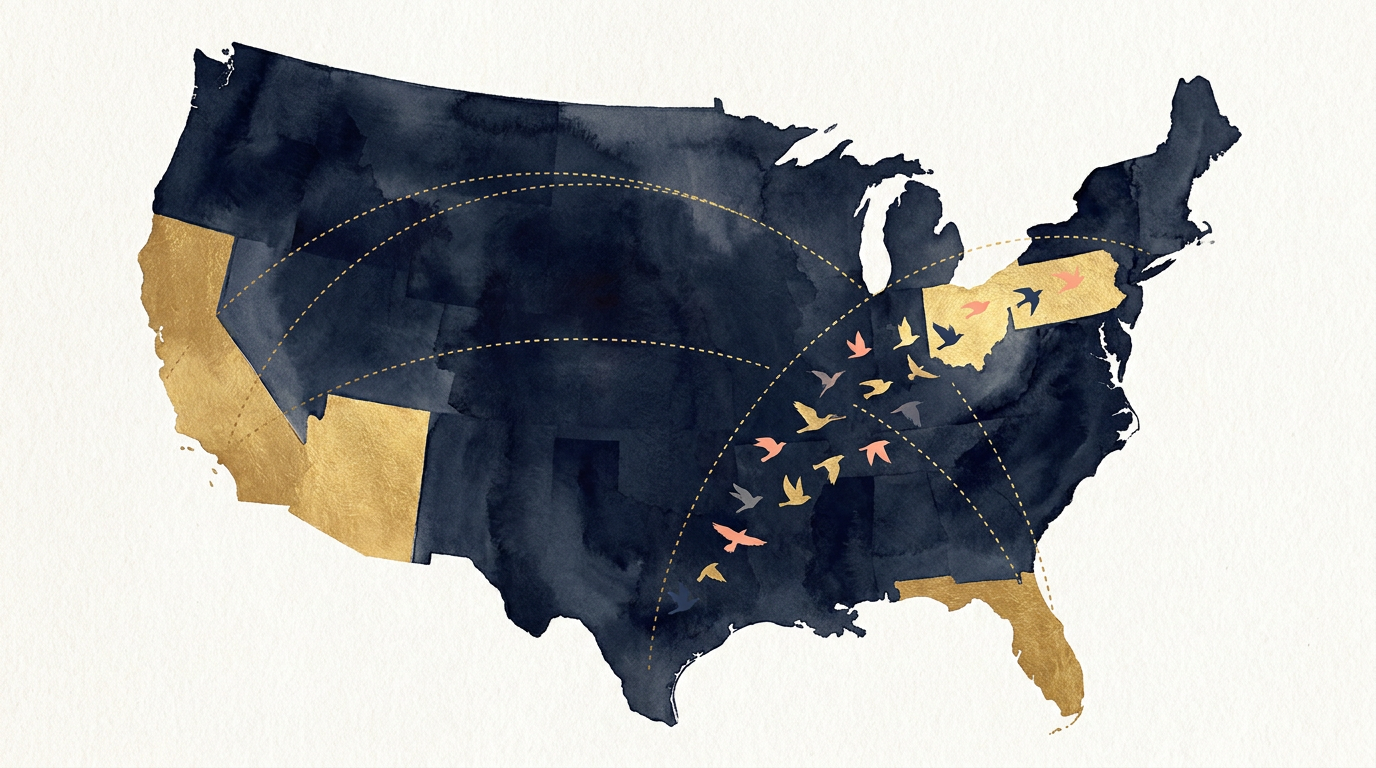
The migration story: the Garden State keeps feeding the Texas boom
The New Jersey → Texas corridor is one of the most consistent migration flows in the country, and it has run in one direction for a decade. IRS migration data — which tracks actual tax returns, not surveys — shows New Jersey lost a net 19,370 income-tax filers to other states between 2022 and 2023 alone, and the households that left carried an average adjusted gross income of roughly $85,500. That is not retirees downsizing; that is prime-earning-years families taking their paychecks somewhere the state doesn’t tax them.
Where do they go? Texas posted a net gain of 56,473 filers in the same IRS window — one of the largest inflows in America — and the Dallas–Fort Worth metroplex captures the biggest share of it. Nearly one in three out-of-state movers to Texas lands in DFW, and between June 2024 and May 2025 more than 265,000 adults moved to Texas from out of state. The Census Bureau now ranks Dallas–Fort Worth as the fastest-growing metro in the nation, adding roughly 152,000 residents in a single year — the population of Paterson showing up every twelve months.
New Jersey, meanwhile, has run a net outflow every single year of the past decade. The pattern is the same one driving the whole Northeast-to-Sunbelt shift: high earners chasing lower taxes, cheaper housing, and employers that moved first. For Newark specifically, the pull is sharpened by geography — DFW sits at the center of the country’s corporate relocation map, so for many households the move follows the job.
Who actually makes this move? Three groups keep showing up in the data: corporate transferees following a headquarters or a banking desk south; remote and hybrid workers keeping a Northeast salary and arbitraging it against Texas costs; and young families who ran the math on a starter home within commuting distance of Manhattan and gave up. What they share is a spreadsheet — this is rarely an impulsive move. It is a calculated one, usually two to three years in the making, and the calculation keeps coming out the same way.

Why they leave: the tax and cost math
This route is, more than almost any other, a tax story. New Jersey pairs a progressive income tax that tops out at 10.75% with the highest property taxes in the nation — the average residential bill hit $9,898 in 2024, and the statewide effective rate of roughly 2.2% is America’s steepest. Texas charges no state income tax at all.
| Newark, NJ | Dallas, TX | |
|---|---|---|
| State income tax | 1.4% – 10.75% (7 brackets) | None |
| Effective property tax | ~2.2% — highest in the US (avg bill $9,898) | ~1.4–1.7% effective, on much cheaper homes |
| Sales tax | 6.625% | 8.25% (Dallas combined) |
| Median home price | ~$615K (up 17.1% YoY) | ~$420K (roughly flat YoY) |
| Overall cost of living | ~14% above US average | ~2% below US average |
Be honest about the fine print, though. Texas funds schools and services through property taxes and sales taxes, so the no-income-tax headline overstates the win: Dallas-area combined property-tax rates are among the highest in the country in their own right, and the 8.25% sales tax outruns New Jersey’s. For a household earning around $120K, the income-tax saving lands in the $4,000–$5,500 a year range — real money — but if you buy a $420K house, expect a property-tax bill in the $6,000–$7,500 neighborhood after homestead exemption. The net is still clearly in Texas’s favor for most working households; it’s just smaller than the bumper sticker says.
Beyond the big three taxes, the everyday ledger tilts the same direction. Overall cost of living in Newark runs about 14% above the national average — housing alone about 35% above — while Dallas sits roughly 2% below it. Groceries, utilities, and services all price a few points under Newark. The notable exceptions: car insurance (Texas rates are high and you’ll likely insure more cars), summer electricity, and toll roads — DFW’s tollway network can quietly cost a daily commuter $100+ a month, a line item PATH riders have never had to budget.
Your new home state
Where to land in Dallas: a neighborhood guide
Dallas is not one market — it’s a quilt of very different neighborhoods stitched together by highways. Four places transplants from North Jersey actually settle, and why:
Oak Lawn Central / walkable-ish
Dense, diverse, and about as close as Dallas gets to an urban neighborhood in the Northeast sense — high-rises and mid-rises, bars and restaurants you can reach on foot, and the heart of the city’s LGBTQ+ community. One-bedroom rents run roughly $1,500–$3,000, which reads like a typo if you’re coming from the Hudson waterfront. If you’re leaving Newark or Harrison and dreading car-everything life, start here.
Bishop Arts District / North Oak Cliff Creative / historic
Craftsman bungalows, indie coffee, galleries, and a genuine main-street strip in a city of malls. Median prices around $425K make it one of the best character-per-dollar buys in Dallas proper, and the community identity is strong — this is the Ironbound-loyalist’s landing spot, the neighborhood people defend like a hometown.
Lake Highlands Families / schools
Northeast Dallas’s “urban-suburban” pocket: rolling hills, big trees, White Rock Lake nearby, and — the headline for parents — most of the area feeds the highly rated Richardson ISD while staying inside Dallas city limits. Median sale prices land around $540K. The closest analog to the North Jersey commuter-town formula, minus the train.
Lakewood Premium / character
1920s bungalows, cottages, and Colonials on leafy streets beside White Rock Lake, with real outdoor life — trails, sailing, the arboretum across the water. It’s the prestige historic neighborhood, and it’s priced like one: recent median sales run north of $1M. Think Montclair with kayaks and without the income tax.
The housing market reality in 2026
Dallas in 2026 is a buyer’s market by Texas standards. The median sale price sits around $420K (Redfin’s average hovers near $475K), essentially flat to slightly down year-over-year, with more listings and longer days-on-market than the frenzy years. Builders in the northern suburbs — Frisco, McKinney, Prosper, Celina — kept building through the boom, so new-construction supply keeps a lid on prices in a way that simply doesn’t exist in land-locked North Jersey.
Contrast that with what you’re selling: Newark’s median hit roughly $615K, up 17.1% year-over-year, in one of the tightest housing markets in the country. That spread is the engine of this move — sell into a seller’s market, buy in a buyer’s market, and the same money buys a different life. A Newark two-family’s equity becomes a four-bedroom with a yard and a pool budget.
Two line items Northeast buyers always underestimate: property taxes are escrowed on a much higher rate than the sticker suggests (protest your appraisal — everyone does), and home insurance is expensive and rising, because North Texas is hail country. Budget both before you fall in love with the granite countertops.
If you’re renting first — the standard playbook, and the right one — the contrast is just as stark. Dallas has been in a genuine apartment glut: years of aggressive multifamily construction mean concessions, free months, and negotiable rents across most of the metro, while Newark renters have spent the decade absorbing increases. A one-bedroom in a walkable Dallas neighborhood typically runs $1,500–$3,000, and the top of that range buys amenity-stacked new construction. Rent for a year, learn the map, then buy into the buyer’s market.
Jobs and the economy
DFW’s job market is the deepest in Texas and one of the deepest in America. The metro added over 14,000 tech jobs in 2025, pushing total tech employment to roughly 243,000, and it’s projected to add the second-most tech jobs of any US metro in 2026, with AI roles the fastest-growing category. Average tech pay runs about $121,700, up 4.5% year-over-year — and remember, that’s pre-tax in a state that doesn’t tax it.
The corporate bench is remarkable: AT&T, American Airlines, Southwest Airlines, Texas Instruments, McKesson, CBRE, and Toyota North America are all headquartered in the metroplex, and the banking build-out — JPMorgan Chase, Bank of America, Charles Schwab, Goldman Sachs’s growing Dallas campus — has earned the region its “Y’all Street” nickname. Healthcare anchors the other end: UT Southwestern, Baylor Scott & White, Texas Health Resources, and Parkland each employ more than 10,000 people.
One honest caveat: wage growth has cooled — DFW wages rose just 1.8% in the year ending March 2026, trailing the ~3.4% national pace — and finance salaries average about $92,700, a touch under national. You come here for the cost side of the ledger and the sheer volume of openings, not for a Northeast-sized paycheck.
The honest trade-offs
 No route guide is honest without this section. The things North Jersey transplants actually struggle with after the boxes are unpacked:
- The heat is real. Average August highs sit around 96°F, and triple-digit stretches are normal. June through September is an indoor season the way January is in Newark — you trade snow days for AC bills that can top $300 a month in a big house.
- You will drive everywhere. DART light rail exists and is genuinely useful downtown, but it is not NJ Transit, and there is no PATH. Most households need a car per adult, with insurance and 20,000-mile years to match. Budget the second car into the cost-of-living math.
- Property taxes and insurance claw back part of the win. The no-income-tax headline is true, but escrow on a $420K house plus hail-belt home insurance will remind you monthly that Texas gets paid somehow.
- The distance is real. Sunday dinner in the old neighborhood becomes a ~3.5-hour nonstop into EWR. It’s an easy flight — DFW and Love Field between them fly everywhere, constantly — but it’s a flight, not a drive.
- Culture shift. Dallas is polished, car-scaled, and spread out. The bodega-and-block texture of North Jersey doesn’t transplant; the neighborhoods above are where people go looking for it.
Planning the move: logistics, cost, and timing
What the corridor actually costs in 2026, by shipment size:
| Home size | Full-service movers | Container (you load) | Rental truck (DIY) |
|---|---|---|---|
| Studio / 1-bedroom | ~$2,750–$3,500 | ~$1,900–$2,800 | ~$1,250–$1,900 |
| 2–3 bedrooms | $3,460–$7,100 | $2,200–$4,230 | $1,700–$2,720 |
| 4–5 bedrooms | $7,500–$11,850 | $4,000–$6,500 | $2,300–$3,200 + fuel |
Numbers are moveBuddha’s 2026 route pricing for New Jersey → Texas; professional packing adds roughly $900–$1,500. Two timing rules do most of the work: move October through April if you can (the same truck costs meaningfully less than in June), and book 6–8 weeks out — mid-month, mid-week pickups price best. Get at least three binding estimates from carriers, not brokers, and verify every USDOT number before you sign anything.
Once you land, Texas gives you deadlines: register your vehicle within 30 days (safety inspection first), swap your NJ license for a Texas one within 90 days, and — if you bought — file your homestead exemption with the county appraisal district, which caps assessment growth and trims the tax bill. Set up electricity before move-in day: most of DFW is deregulated, so you choose a provider, and a little comparison shopping on a summer-heavy plan matters more than it sounds.
Frequently asked questions
How much does it cost to move from Newark to Dallas?
In 2026, full-service movers run about $2,750 for a one-bedroom up to $11,850 for a large house, per moveBuddha route pricing for New Jersey to Texas. Moving containers cost roughly $2,200 to $4,230 for a typical two-to-three-bedroom move, and a one-way rental truck runs about $1,250 to $2,720 before fuel. Timing, access, and packing services move the final number more than anything else.
How far is Dallas from Newark, and how long does the move take?
It is roughly 1,550 miles door-to-door, about 23 hours of driving — a comfortable 2.5-to-3-day drive via I-78, I-81, I-40, and I-30. Van lines typically quote delivery windows of 4 to 9 business days on this corridor.
How much will I actually save on taxes in Texas?
Texas has no state income tax, versus New Jersey’s 1.4% to 10.75% brackets, so a household earning around $120,000 keeps roughly $4,000 to $5,500 a year. But Texas property taxes (about 1.4% to 1.7% effective in the Dallas area) and an 8.25% sales tax claw some back. Most working households still come out clearly ahead — especially because the median Dallas home costs about $195,000 less than Newark’s.
What is the best Dallas neighborhood for someone from North Jersey?
For walkable, urban energy, Oak Lawn is the closest match. Bishop Arts in North Oak Cliff offers historic character and a strong community feel around a $425K median. Families usually look at Lake Highlands for Richardson ISD schools, while Lakewood is the premium historic pick by White Rock Lake.
When is the best time to move from Newark to Dallas?
October through April is the value window — summer (May to August) is peak season on every long-distance corridor and prices rise sharply. Book 6 to 8 weeks ahead and aim for mid-month, mid-week pickup dates. One bonus: arriving in fall or winter lets you settle in before your first Texas summer.
Keep exploring
Sources: IRS SOI & Census state-to-state migration data; Tax Foundation 2026; Redfin & Zillow, January–July 2026; RentCafe & Apartments.com cost-of-living comparisons 2026; BLS Dallas–Fort Worth area employment & employment-cost data 2026; CompTIA / Dallas Innovates tech-workforce reporting 2026; moveBuddha 2026 route pricing.