
Free calculator
Rent a truck, or hire movers?
See real numbers for a Buffalo → San Antonio move — we factor in real rental-truck fuel burn (a loaded 26-footer gets ~7–8 mpg), one-way rental, hotels, and gear, then compare it to full-service movers.
Every year, a steady stream of Western New York households trades lake-effect snow, aging driveways, and a New York State tax return for Military City USA. The Buffalo-to-San-Antonio move is one of the longest common corridors out of the Northeast — 1,640 miles, two time-zone-adjacent worlds — and it is not the move most people assume it is. You will not slash your housing bill. You will, very likely, raise your household income, delete a five-figure line from your lifetime tax bill, and never shovel again. Here is what the numbers actually say in 2026.
The migration story: a decade of one-way traffic
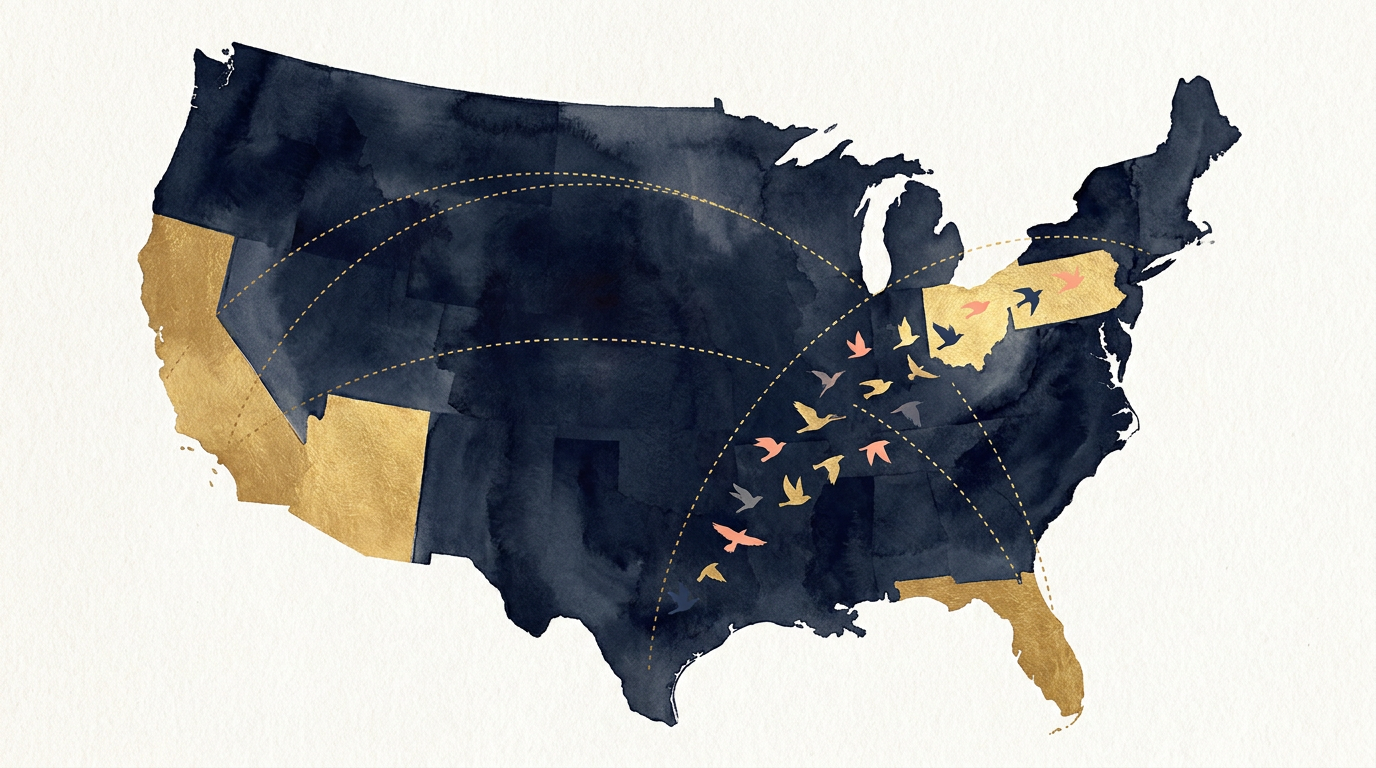
The raw numbers are hard to argue with. In the most recent IRS county-to-county migration data, Texas posted a net gain of 88,216 tax filers from interstate moves in a single year — second only to Florida — while New York sat at the very bottom of the table, alongside California and Illinois, as one of the nation’s biggest net losers. Tax Foundation analysis of the same IRS files shows the pattern holds across income levels, and gets stronger the higher up the income ladder you look.
San Antonio has been one of the biggest single beneficiaries. The city added 23,945 residents between 2023 and 2024 — the fourth-largest numeric gain of any U.S. city — and Census Bureau reporting shows the boom is driven primarily by domestic movers arriving from other states, not local births. The most recent estimates (July 2024 to July 2025) added another ~14,000 people, second in the nation behind Fort Worth, and demographers now expect San Antonio to pass Philadelphia to become America’s sixth-largest city within a few years.
Here is the honest part, though: Buffalo is not the dying Rust Belt story this corridor gets written up as. Buffalo home values are rising — up 3.1% year over year in mid-2026, with houses drawing five offers on average and selling in about 30 days at over full asking price. People who make this move are not fleeing a collapsing market. They are chasing a bigger paycheck (San Antonio’s median household income is nearly $15,000 higher than Buffalo’s), a deeper job market, and a winter that does not require a snow blower. Buffalo’s own military families know the pattern well — thousands of service members cycle through Joint Base San Antonio every year, and a striking number of them come back to stay when they retire.
Who actually makes this exact move? Three groups keep showing up. Service members and veterans first — Joint Base San Antonio touches every branch’s training pipeline, and Western New York sends its share of recruits through Lackland every year; some fraction of them never really leave, and their families follow. Second, healthcare workers: Buffalo’s medical corridor trains nurses, techs, and physicians who find San Antonio’s enormous hospital systems hiring on better pay scales with no state tax bite. Third, and growing fastest, remote and hybrid workers doing Northeast salaries from a Texas cost basis — for them the income-tax arithmetic alone can cover a car payment. What all three have in common: they are moving toward something specific, not just away from winter.

Why they move: the tax and paycheck math
Unlike the New Jersey and downstate corridors, the Buffalo-to-San-Antonio move is not primarily a property-tax escape — it is an income-tax and income-level story. New York’s state income tax runs from 4% to 10.9%; Texas famously has none. A Buffalo household earning $85,000 sends roughly $4,000–$4,500 a year to Albany. In Texas, that line item is zero — every year, forever.
| Buffalo, NY | San Antonio, TX | |
|---|---|---|
| State income tax | 4% – 10.9% | None |
| Median effective property tax | ~1.90% (NY median, Ownwell) | ~1.55% (Bexar County median, Ownwell) |
| Combined sales tax | 8.75% | 8.25% |
| Median home (mid-2026) | $205K sale / $246K value (Redfin / Zillow) | $260K sale / $251K value (Redfin / Zillow) |
| Median household income | $48,050 | $62,917 |
| Market direction | +3.1% YoY, seller’s market | −2.6% YoY, buyer’s market |
Two honest caveats. First, Texas funds its no-income-tax promise through property and sales taxes, so do not expect your property-tax bill to shrink much — on a $300,000 Bexar County home, a 1.55% effective rate is roughly $4,650 a year, and newer suburbs with special districts can run higher. Second, day-to-day cost of living is broadly comparable: Numbeo’s 2026 comparison finds you need about $5,985 in San Antonio to match a $6,400 lifestyle in Buffalo (renting) — a modest 6–7% edge, not a windfall. The durable wins are the income-tax zero and the higher local wages.
Where to land: four San Antonio neighborhoods that make sense from Buffalo
San Antonio is enormous — over 500 square miles, a patchwork of master-planned suburbs, historic districts, and everything between. These four areas cover the spread most Buffalo transplants actually choose from.
Tobin Hill & the Pearl Urban / walkable
If you love Elmwood Village or Allentown, start here. Tobin Hill wraps around the Pearl — the former brewery turned riverside food-and-culture district — with the Museum Reach of the River Walk running through it. Historic craftsman homes mix with new mid-rise condos, and the 2026 median sits near $360,000, a premium for San Antonio but modest by walkable-neighborhood standards anywhere in the Northeast. This is the closest the city gets to street life you can reach on foot.
Stone Oak Families / master-planned
The north-side default for relocating families: gated subdivisions, newer builds, highly rated schools, and one of the metro’s big medical corridors close by. Median prices hover around $450,000, and you trade character for space, safety, and predictability. It is a 25–35 minute run downtown on US-281 — think of it as San Antonio’s Clarence or East Amherst, with palm trees.
Alamo Heights Premium / schools
The old-money classic, five miles north of downtown: oak-canopied streets, a walkable strip of shops and restaurants, and its own school district that consistently ranks among the best in Texas. Median values approach $700,000+ — Buffalo money does not stretch here, but for households moving on a strong Texas salary it is the quality-of-life pick, the Nye Park of San Antonio.
Shavano Park & the northwest corridor Space / quiet
Leafy, low-key, and incorporated separately from the city, Shavano Park and the neighborhoods around it offer larger lots, low crime, and quick access to the Medical Center and USAA’s headquarters campus. It is the choice for people who came for the Texas trade — more house, more land, less noise — without going full exurb.
Housing market reality in 2026
This corridor has a plot twist: you are selling in a hot market and buying in a soft one, which is exactly the order you want. Buffalo in mid-2026 is one of the most competitive markets in the country — a $205K median sale price, up 3.1% year over year, five offers per listing, homes pending in about 10 days, and just 3.5 months of supply. Priced sensibly, your Buffalo house will move fast and likely over ask.
San Antonio is the mirror image. The median sale price is about $260,000, down 2.6% from a year earlier; homes average two offers and take around 73 days to sell; price per square foot ($157) has slipped 1.6%; and inventory keeps climbing as builders stay active. Redfin pegs the metro’s median a full 30% below the national average. Translation for a relocating buyer: take your time, negotiate hard, and do not skip the new-build incentives on the far north and west sides. Sell fast, buy slow — this move rewards patience on exactly one end.
Jobs & the economy: what actually pays in San Antonio
San Antonio’s economy runs on four sturdy legs: the military, healthcare, financial services, and an expanding tech-and-cyber sector. Joint Base San Antonio — the umbrella over Lackland, Randolph, and Fort Sam Houston — directly employs more than 82,000 people, supports over 211,000 jobs in the region, and anchors one of the country’s largest military-medical and cybersecurity clusters. USAA, headquartered here, employs roughly 31,000 in insurance, banking, and investments; grocery giant H-E-B keeps about 23,000 on local payrolls at its home base; and the South Texas Medical Center, bioscience employers, and advanced manufacturing round out the base.
The result shows up in the paycheck comparison: San Antonio’s median household income of $62,917 runs almost $15,000 ahead of Buffalo’s $48,050, and six locally headquartered employers made U.S. News’ 2026–27 best-places-to-work list — double the city’s showing two years ago. For two-earner households, the practical math of this move is often a raise on one income, a lateral on the other, and a zero on the state-tax line.

The honest trade-offs
The heat is the new snow. You are trading four real seasons for two: a long, genuinely punishing summer where highs sit at 95°F+ for weeks on end, and a short, mild everything-else. Your utility bill flips — August air conditioning replaces January heat — and outdoor life migrates to mornings and evenings from June through September. People who romanticize escaping Buffalo winters should be equally clear-eyed about San Antonio Augusts.
You will drive everywhere. San Antonio is one of America’s most car-dependent big cities. Transit is thin, the city sprawls across 500+ square miles, and daily life happens on Loop 1604, US-281, and I-10. If your Buffalo life fit inside a 15-minute drive, recalibrate: your new normal is 25–40 minutes to most things that matter.
The tax swap is real but partial. No state income tax, yes — but Bexar County’s ~1.55% effective property tax on a similarly priced house means your property bill will look a lot like your old one, and 8.25% sales tax claws back a little more. The net is clearly positive for most working households; it is just smaller than the brochure version.
There is no housing windfall, and you’ll be far from home. This is the rare Sunbelt move where the destination’s median home costs slightly more than the origin’s. And 1,640 miles is real distance — a two-day drive or a connecting flight from family, Bills Sundays on a screen instead of at the stadium, and wings that will disappoint you until you stop comparing and order the brisket instead.
Planning the move
| Home size | Estimated cost (2026) |
|---|---|
| Studio / 1-bedroom | $1,400 – $3,200 |
| 2-bedroom | $2,900 – $5,600 |
| 3-bedroom | $4,200 – $8,300 |
| 4+ bedroom | $6,500 – $12,500+ |
Those ranges track moveBuddha’s 2026 dataset, which puts most professional 2–3 bedroom long-distance moves at $3,060–$5,280; industry pricing overall is up roughly 21% in 2026 on fuel costs, so lock quotes early. Renting a truck and driving it yourself can cut the bill roughly in half — at the price of three long days at the wheel of a 26-footer getting 7–8 mpg.
Arrival logistics, briefly. Texas will want some paperwork in your first weeks: new residents have a window to swap their New York license for a Texas one and to title and register vehicles, so budget an early DMV afternoon. Get homeowners-insurance quotes before you buy rather than after — Texas premiums run high by national standards because of hail and wind exposure, and the quote can change which house makes sense. And if you are bringing a Buffalo-hardened car, it will be fine; it is the July sun, not the road salt, that ages things here.
Timing: October through April is the value window; May through August is peak season with premium pricing on this corridor. Aim for mid-month, mid-week pickup dates. And there is a genuinely elegant play here: move in fall, and you skip your first Texas summer and your last Buffalo winter in a single stroke.
Frequently asked questions
How much does it cost to move from Buffalo to San Antonio?
Most professional 2-bedroom moves run $2,900–$5,600 in 2026; studios start around $1,400 and large family homes can reach $8,300–$12,500+. A one-way rental truck is roughly half the full-service price, before fuel, hotels, and three days of your time.
How far is Buffalo from San Antonio, and how long does the move take?
About 1,640 miles — roughly 24 hours of driving, comfortably done in three days via the I-44 corridor. Professional van lines typically deliver within a 5–10 business-day window on this route.
How much will I actually save on taxes in Texas?
Texas has no state income tax, so a household earning $85,000 keeps roughly $4,000–$4,500 a year that would have gone to New York. Offsetting that, Bexar County’s ~1.55% effective property tax and 8.25% sales tax claw some back — most working households still come out clearly ahead, just not by the full income-tax amount.
What’s the best San Antonio neighborhood for someone from Buffalo?
For Elmwood Village energy, look at Tobin Hill and the Pearl (median near $360K). Families usually land in Stone Oak (~$450K) for schools and space; Alamo Heights is the premium schools-and-charm pick at $700K+; Shavano Park offers quiet lots near USAA and the Medical Center.
When is the best time to make this move?
October through April brings the best pricing and availability. A fall move is the sweet spot: you avoid peak-season rates, skip your first 100°F San Antonio summer, and never see another lake-effect storm.
Keep exploring
Sources: U.S. Census Bureau population estimates (Vintage 2024–2025); IRS Statistics of Income migration data and Tax Foundation analysis; Redfin and Zillow market data, May–June 2026; Ownwell county property-tax records; Numbeo cost-of-living comparison, 2026; moveBuddha 2026 pricing dataset; Greater SATX Regional Economic Partnership employer data.